28th Aug 2026
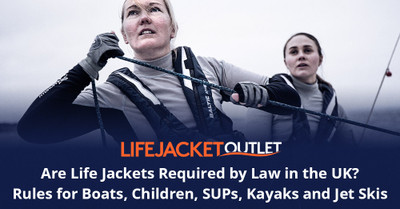
For most adults using a small private pleasure boat in the UK, there is no blanket national law requiring a life jacket to be worn at every moment. That is only the beginning of the answer. Requirements change for larger pleasure vessels, commercial and coded boats, some organised activities and locations governed by local rules.
The legal minimum and the safe decision are not the same. A suitable, correctly fitted life jacket or buoyancy aid should be selected for every person, and the skipper should set a clear wearing policy before departure. This guide separates the main UK scenarios so that boat owners and watersports users can make a properly informed decision.
Important legal distinction
UK requirements depend on the vessel, its length, where and how it is operated, and whether it is genuinely private pleasure use. This guide explains the general position for buyers, but it is not a substitute for the current regulations, a harbour direction, event rules or professional legal advice.
Contents
- Key facts at a glance
- Private pleasure boats under 13.7 metres
- Pleasure vessels 13.7 metres and over
- Commercial, coded and workboats
- SUPs, kayaks, jet skis and organised activities
- Are life jackets compulsory for children?
- When should a life jacket be worn?
- Choosing equipment that matches the activity
- A practical skipper checklist
- Frequently asked questions
- Technical references
Key facts at a glance
- There is no single UK rule requiring every adult on every small private pleasure boat to wear a life jacket at all times.
- MCA guidance states that private pleasure vessels under 13.7 metres are not subject to a general statutory carriage requirement for life-saving appliances, although other duties and local rules can still apply.
- Private pleasure vessels of 13.7 metres and over fall into the Class XII framework and have specific life-saving-equipment requirements or exemption arrangements.
- Commercial, coded and workboats operate under different requirements; the Workboat Code, for example, requires a suitable life jacket for each person and sets standards, accessory and servicing provisions.
- Harbour authorities, activity providers, clubs, event organisers, employers, insurers and charter operators may impose stricter rules than the general leisure position.
- A lack of a blanket legal obligation is not evidence that it is sensible to go without one. The RYA recommends wearing a suitable life jacket or buoyancy aid unless the skipper has actively assessed that it is safe to remove it.
- Children should wear a correctly sized product rather than an adult model bought for them to grow into.
- The safest equipment is the one that is appropriate, correctly fitted, maintained and actually worn.
| Situation | General UK position | Practical action |
|---|---|---|
| Private pleasure craft under 13.7m | No general statutory requirement to carry life-saving appliances solely because it is a private pleasure vessel of this size. Other rules may still apply. | Carry a suitable device for every person and establish a clear wearing policy based on risk. |
| Private pleasure vessel 13.7m or longer | Class XII life-saving-appliance requirements and current MCA exemptions apply. | Check MGN 599 and the vessel-specific equipment schedule; do not rely on guidance intended for a small open boat. |
| Commercial, coded or workboat | Specific carriage, approval, accessory, spare and servicing requirements may apply. | Use the applicable code and Certifying Authority requirements. |
| SUP, kayak or small sailing craft | No one nationwide rule covers every private recreational use, but local directions, provider rules and activity-specific duties can apply. | Use an activity-appropriate PFD and check the venue, organiser and governing-body rules. |
| Personal watercraft or jet ski | Local harbour rules, launch-site conditions, hire-company rules and event requirements may mandate flotation equipment. | Wear a secure, impact-compatible buoyancy aid or life jacket intended for the activity. |
| Child on a private family boat | There is no simple nationwide age threshold applying to every private leisure craft. | Make wearing a correctly sized children’s life jacket the default, not a legal-minimum exercise. |
Choose equipment for the people and activity on board
Compare adult, junior, automatic, manual and activity-specific options rather than treating every personal flotation device as interchangeable.
Private pleasure boats under 13.7 metres
For a vessel to benefit from the private pleasure-vessel position, it must genuinely be used for the sport or pleasure of the owner, their immediate family or friends. Payment is not the only test of commercial use. A boat used for business purposes, paid trips, instruction, work, surveying, demonstrations or another non-pleasure purpose may fall into a different regulatory framework even when it looks like an ordinary leisure craft.
Current MCA guidance explains that pleasure vessels under 13.7 metres are not covered by a general statutory requirement to carry fire-fighting or life-saving appliances. That statement is often shortened online to “life jackets are not legally required”, but the shorthand omits important qualifications. It does not cancel the skipper’s responsibility for the safety of people on board, local harbour directions, navigation-authority rules, employment duties, racing instructions, charter conditions or insurance requirements.
It also does not mean that any flotation product will do. A buoyancy aid is primarily intended to assist a conscious swimmer in suitable conditions. A properly selected life jacket is designed to provide greater support and, depending on its performance level and the wearer’s clothing, help turn the wearer into a safer face-up position. The existing life jacket versus buoyancy aid guide explains that distinction in more detail.
Do not confuse “not universally compulsory” with “not needed”
A person can enter the water without warning after a collision, trip, boom strike, equipment failure or medical event. There may be no opportunity to retrieve and put on equipment stored below. A comfortable jacket worn throughout the trip offers protection at the moment it is needed.
Pleasure vessels 13.7 metres and over
The position changes at 13.7 metres. UK merchant-shipping regulations classify pleasure vessels at or above this length as Class XII vessels for relevant life-saving and fire-protection purposes. The MCA has published exemptions that allow suitable small-craft equipment to be carried instead of some large-ship equipment, provided the conditions of the exemption are met.
Owners should use the current version of MGN 599 and its annexes, not a forum summary or an old marina checklist. Required quantities and specifications depend on vessel length, operating area and other factors. Equipment may include suitable life jackets for each person, lights, lifebuoys, liferafts and communications equipment, with servicing and approval requirements attached.
The practical lesson is simple: once a private pleasure vessel reaches 13.7 metres, the skipper should maintain a vessel-specific compliance file. Record product approvals, serial numbers, service dates, replacement dates and the number and size range carried. A jacket for an adult is not automatically suitable for a person under 32kg, and an accessory fitted for leisure convenience may not satisfy a mandatory commercial or Class XII specification.
Commercial, coded and workboats
Commercial and coded vessels must be assessed under the code or regulations that apply to their operation. The current Workboat Code Edition 3 illustrates how different that regime can be. It specifies recognised construction standards, a whistle and retro-reflective material, lights for certain operating categories, a suitable life jacket for each person, additional inflatable jackets, re-arming kits and spray hoods for particular operating areas, and servicing in accordance with the manufacturer’s recommendations.
This is why a product described as suitable for general leisure boating is not automatically the right choice for a survey vessel, harbour launch, workboat or paid activity. Commercial purchasers should confirm required approval, Newton level, inflation system, light, spray hood, harness arrangement, compatibility with workwear and service regime with the vessel’s Certifying Authority or competent adviser.
Buying for professional or coded use?
Browse purpose-designed commercial models, then confirm the precise code, approval and accessory requirements before ordering.
SUPs, kayaks, jet skis and organised activities
Stand-up paddleboarding, kayaking, dinghy sailing and personal-watercraft use do not sit neatly under one universal nationwide wearing rule. The legal and contractual position can change with the waterway, harbour, launch site, organised event, training provider or hire agreement. A reservoir operator can require a buoyancy aid even when a privately owned board on another stretch of water is not subject to the same local condition.
Activity also changes the most suitable equipment. A bulky inflatable yacht life jacket may snag, restrict self-rescue or inflate unnecessarily during an activity where immersion is expected. Conversely, a low-buoyancy watersports aid may be inadequate for a non-swimmer, a lone offshore paddler, someone in heavy clothing or a person who may be unconscious.
| Activity | Typical equipment direction | Questions to ask |
|---|---|---|
| Sheltered-water SUP | SUP-specific buoyancy aid or suitable PFD, selected with leash strategy and venue conditions in mind. | Is help close? Is the paddler a confident swimmer? Is a waist leash safe for this environment? |
| Kayaking | Kayak buoyancy aid with arm freedom and secure fit for self-rescue. | Will the user need to roll, swim, climb back in or carry rescue equipment? |
| Jet ski / personal watercraft | Secure watersports PFD designed for speed, repeated immersion and movement. | Does the harbour, organiser or hire provider specify a product standard or impact features? |
| Yacht or motorboat cruising | Often an automatic inflatable life jacket suitable for the operating area and clothing. | Could the wearer be unconscious? Are spray hood, light and harness needed? |
| Dinghy sailing or activity with expected capsize | Often a close-fitting foam buoyancy aid rather than a conventional automatic inflatable jacket. | Is immersion part of normal use? Could inflation obstruct recovery or entrap the wearer? |
The dedicated SUP buoyancy-aid guide covers paddleboarding in more detail. Whatever the activity, check the current local and organiser rules before launch rather than assuming that advice for a yacht applies unchanged.
Are life jackets compulsory for children?
There is no single UK-wide rule stating that every child below a particular age must wear a life jacket on every private leisure boat. That differs from some other countries and is a common source of confusion in search results. Local authorities, activity centres, hire operators and events can impose their own rules, and a commercial vessel must comply with its applicable code.
For family boating, the sensible policy is much clearer than the legal minimum: children should wear a properly sized life jacket whenever they are on a pontoon, tender, open deck or small craft, and whenever there is a realistic risk of entering the water. The product should match the child’s current weight and chest range. It should include the retention features specified by the manufacturer, typically crotch or thigh straps, and should never be bought oversized for future growth.
Very young children generally need inherent foam buoyancy, strong head support, secure retention and a lifting handle. Older juniors may have foam or inflatable choices depending on their weight, maturity, activity and the manufacturer’s specification. Use the children’s life jacket guide and browse kids’ life jackets by the stated weight range rather than age alone.
When should a life jacket be worn?
A useful onboard rule is to start from “wear it” and relax that rule only after a deliberate risk assessment. Conditions can deteriorate quickly, and the point at which everyone decides they now need a life jacket may also be the point at which fitting one safely becomes difficult.
- Wear one on tenders, open boats and personal watercraft.
- Wear one when sailing or motoring alone, at night, in poor visibility or in cold water.
- Wear one on deck in rough conditions, during sail changes and while anchoring or handling lines.
- Wear one when crossing bars, harbour entrances or exposed areas.
- Wear one if the wearer is a weak or non-swimmer, has reduced mobility or may be affected by a medical condition.
- Wear one with a suitable harness and safety line when the risk assessment requires clipping on.
- Keep children in correctly fitted equipment before they step onto the pontoon, not only after the boat leaves.
The skipper should brief the crew on fastening, crotch straps, manual inflation, oral inflation, lights, spray hoods and any attached locator beacon. A jacket that is aboard but unfamiliar may not deliver its full benefit in an emergency.
Choosing equipment that matches the activity
Legal compliance is only one input. The correct product also depends on water conditions, likely rescue time, whether immersion is expected, the wearer’s swimming ability, clothing, body shape and the possibility of unconsciousness. A 150N-class inflatable jacket is a common choice for general coastal and offshore leisure use, while higher-buoyancy models can be appropriate for extreme conditions, heavy protective clothing and demanding commercial use. Higher numbers are not a substitute for fit, comfort or suitability.
Choose between automatic and manual life jackets according to the activity and accidental-inflation risk. Consider a spray hood, life jacket light, whistle, crotch straps, harness and a personal locator beacon where the operating area justifies them. Accessories must be compatible with the exact jacket and fitted without compromising inflation.
The best legal answer is not always the best safety answer
For many private boaters the law leaves room for judgement. Use that freedom to adopt a stronger onboard standard, not to remove equipment that could save a life.
A practical skipper checklist
- Confirm the vessel’s status. Is it private pleasure use, temporary commercial use, coded, chartered, a workboat or an organised activity?
- Confirm the vessel length and operating area. Do Class XII, local harbour, navigation-authority or code requirements apply?
- Provide a suitable device for every person. Include child-specific sizes and account for guests with unusual chest measurements or reduced mobility.
- Set a wearing policy before departure. Define when jackets and safety lines are mandatory and make the rule clear to everyone.
- Inspect and fit each product. Check the cylinder, indicators, webbing, buckle, crotch straps, light, hood and service status.
- Brief the crew. Demonstrate manual inflation, hood deployment, light operation and how to raise the alarm.
- Record mandatory equipment. For regulated vessels, retain service certificates, approval details and replacement records.
- Check local information. Review harbour notices, event instructions, hire terms and insurer requirements for the intended trip.
Frequently asked questions
Is it illegal not to wear a life jacket on a small private boat in the UK?
There is no universal UK rule requiring every adult to wear one at all times on every private pleasure craft under 13.7 metres. Specific local, activity, employment, charter or event requirements may apply, and the skipper still has responsibility for safety.
Do I legally have to carry one life jacket per person?
For a small private pleasure vessel under 13.7 metres there is no general statutory life-saving-appliance carriage requirement solely on that basis. Larger, commercial and coded vessels are different. Good practice is to carry a correctly sized, serviceable device for every person and have it readily available or worn.
Are children legally required to wear life jackets in the UK?
There is no single nationwide age rule covering every child on every private leisure boat. Local and commercial rules may be stricter. A correctly fitted children’s life jacket should nevertheless be the default safety policy.
Do I need a life jacket on a paddleboard?
The precise legal position can depend on the venue and organiser. From a safety perspective, use an activity-appropriate PFD selected with the water, wind, leash system, swimming ability and distance from help in mind.
Are life jackets compulsory on a jet ski?
Local harbour, launch-site, hire and event rules commonly require them. Even where no specific local rule is identified, a securely fitted PFD designed for personal-watercraft use is fundamental safety equipment.
Does a commercial life jacket automatically satisfy every code?
No. The applicable code may specify approval, buoyancy, light, spray hood, inflation type, service interval and spare equipment. Confirm the precise vessel requirement before purchase.
Technical references
Rules and guidance can change. Check the latest source documents and any local directions before relying on this article.