18th Sep 2026
A dog life jacket must fit closely enough to stay on in the water while allowing the dog to breathe, paddle and move normally. Breed name or body weight alone is not enough because dogs of similar weight can have very different chest, neck and back proportions.
This guide explains which measurements to take, how to interpret a brand size chart and how to test the finished fit safely before the dog goes near a boat or open water.
Use the exact brand size chart
Dog life jacket sizing is not standardised. A medium in one range can differ from a medium in another, and some brands prioritise girth while others also use weight, neck and back length. Measure the dog, then apply the current chart for the exact product.
Contents
- Direct answer
- Measurements to take
- Step-by-step measuring method
- How a dog life jacket should fit
- Breed shape and proportion
- Buoyancy, head support and handles
- Introducing the jacket safely
- Controlled water test
- When the size or jacket needs replacing
- Buying checklist
- Frequently asked questions
- Technical references
How do you measure a dog for a life jacket?
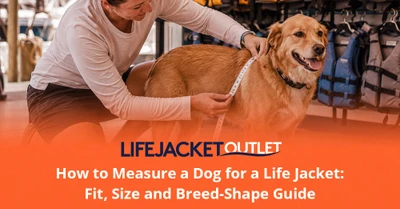
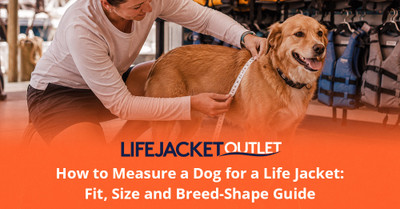
Measure the dog while it is standing naturally. The most important measurement for many dog life jackets is the chest or ribcage girth around the widest part behind the front legs. Also record weight, neck circumference and back length from the base of the neck to the base of the tail where the brand chart requests them. Use a soft tape that touches the coat without compressing the chest.
Select the size using the manufacturer chart, not breed name alone. Fit the jacket so it is snug and cannot slide over the shoulders or rotate, but does not restrict breathing, front-leg movement or swimming. Every strap must remain within its adjustment range, with excess secured and no buckle rubbing the armpit or groin.
| Measurement | Where to measure | Why it matters |
|---|---|---|
| Chest/ribcage girth | Around the widest part of the ribcage, usually just behind the front legs. | Often the primary sizing measurement and the key to preventing the jacket sliding off. |
| Weight | Use an accurate recent weight. | Helps confirm that the flotation and structural design suit the dog, but does not replace girth. |
| Neck circumference | Around the lower neck where the front panel or strap sits. | Important for broad heads, short necks and preventing forward escape. |
| Back length | Base of neck/shoulders to base of tail, as defined by the brand. | Checks that the jacket supports the torso without obstructing the tail or hips. |
| Body depth and shape | Observe chest depth, waist taper, shoulder width and coat thickness. | Two dogs with the same girth can need different panel and strap geometry. |
Compare dog life jackets by size and body shape
Browse flotation jackets for small and large dogs, with dedicated routes for common shapes including dachshunds, bulldogs and Labradors.
Measurements to take before ordering
1. Chest or ribcage girth
Place the tape around the deepest and widest part of the chest, normally immediately behind the front legs. Keep it level and allow the dog to breathe normally. Thick fur should be gently compressed to the level it will sit beneath the straps, but do not pull the tape tight enough to distort the ribcage.
2. Weight
Weigh the dog on a veterinary, pet or household scale using a safe method. Weight helps the manufacturer match buoyancy and component strength, but shape can vary dramatically at the same weight. A compact bulldog and a long, narrow dog may occupy different sizes despite similar kilograms.
3. Neck circumference
Measure where the jacket neck opening or front strap will rest, not high under the ears unless the chart instructs otherwise. Confirm that the dog cannot reverse out through the opening. Broad-headed dogs may need enough opening to put the jacket on while still allowing secure adjustment once fitted.
4. Back length
Use the points defined by the brand, commonly from the base of the neck or shoulder blades to the base of the tail. A jacket that is too long can interfere with the hips and tail; one that is very short may concentrate flotation and fail to support the torso as intended.
5. Coat and seasonal change
Record whether the dog is clipped, double-coated, wet-coated or likely to wear another garment. Measure the dog rather than adding an arbitrary allowance. Recheck after weight change, growth, grooming or a major coat change.
Step-by-step measuring method
- Stand the dog on a level, non-slip surface. The spine should be neutral and all four feet comfortably placed.
- Use a flexible tape. A rigid ruler cannot follow the ribcage accurately.
- Measure chest girth twice. Record the widest consistent figure while the dog breathes normally.
- Record weight. Do not estimate from breed or an old veterinary visit.
- Measure neck and back where requested. Follow the diagram supplied for the exact life jacket.
- Compare every figure with the chart. Do not choose solely from the first measurement that fits.
- Handle boundary sizes cautiously. If the dog sits between sizes or has unusual proportions, ask the retailer or manufacturer rather than automatically sizing up.
- Keep the measurements. They are useful when comparing a different brand or rechecking fit next season.
Measure in centimetres and kilograms unless the chart uses another unit. Converting carelessly between inches and centimetres is a common source of incorrect orders.
How a dog life jacket should fit
A correctly fitted jacket should remain centred over the dog and move with the torso. The flotation panels should not twist to one side, ride into the throat or slide backwards. The dog should be able to walk, sit, lie down and extend the front legs without obvious restriction.
| Fit check | Good fit | Poor fit |
|---|---|---|
| Chest straps | Snug, secure and within the intended adjustment range. | Loose enough for the dog to back out, or tight enough to restrict breathing. |
| Neck/front panel | Supports without pressing the windpipe or riding into the jaw. | Large gap, choking pressure or interference with head movement. |
| Shoulders and front legs | Full stride and swimming reach. | Panel or buckle rubs the armpit or blocks extension. |
| Back panel | Centred and stable along the torso. | Rotates, bunches, extends over the tail or leaves most of the torso unsupported. |
| Belly panel | Distributes pressure and does not fold into soft tissue. | Narrow strap cuts in, twists or sits directly in the groin. |
| Lift handle | Centred over a supported section of the body. | Handle twists the jacket or places all load on one thin strap. |
| Escape check | Jacket cannot be pulled forward over the shoulders with moderate hand pressure. | Dog can reverse out or head slips through the front opening. |
A two-finger rule is only a rough check
Some products and body shapes need a different clearance. The decisive test is secure retention without breathing or movement restriction, using the brand instructions and a controlled dry-land and shallow-water assessment.
Breed shape and proportion
Deep-chested and narrow-waisted dogs
Greyhound-type shapes can have a large chest measurement but a narrow waist and neck. Look for multiple adjustment points and a belly panel that prevents rotation. A size chosen only by girth can otherwise be loose behind the ribcage.
Long-backed, short-legged dogs
Dachshunds and similar dogs need enough torso coverage without a jacket that hangs below the chest, catches the front legs or extends over the tail. Compare the dedicated sausage dog life jacket options and check back length carefully.
Broad-chested, short-necked dogs
Bulldogs and other compact breeds can have a broad head, short neck and heavy front end. Neck-opening geometry and front buoyancy deserve extra attention. Browse bulldog life jackets and confirm that the jacket does not force the head into an uncomfortable position.
Small dogs
A small dog needs low-bulk panels, light hardware and straps that genuinely tighten to the stated range. Oversized buckles can be disproportionately uncomfortable. The small dog range and Chihuahua options provide a more focused starting point.
Large and heavy dogs
Large dogs create greater recovery loads and need robust straps, panel support and an appropriate handle design. A handle is generally an assisted-recovery aid, not permission to suspend the dog at height for an extended period. Browse large dog life jackets and Labrador life jackets, then check the actual measurement range.
Buoyancy, head support and handles
Dog life jackets distribute flotation differently. Some focus on the torso; others add a front float beneath the chin. No product guarantees that every dog will remain in one orientation, because body shape, coat, movement, waves and fit affect behaviour in the water. A controlled test is therefore important.
- Torso flotation: should support the ribcage without rolling excessively.
- Neck or chin float: can help support the head but must not press the throat or restrict panting.
- Belly panel: can spread loads more comfortably than narrow straps and improve stability.
- Recovery handle: should be easy to locate and connected to a sufficiently supportive structure.
- High-visibility fabric and reflective trim: improve visual detection but do not replace close supervision.
- Lead attachment: use only if the manufacturer identifies it for that purpose; it is not automatically a lifting or tether point.
The existing dog life jacket safety guide explains why even strong swimmers can benefit from flotation around boats, cold water, currents and unfamiliar exits.
Introducing the jacket safely
A dog that freezes, scratches or rolls when first fitted is not ready for the water. Introduce the product in short, positive sessions indoors or on dry land. Let the dog investigate it, then fasten it briefly and reward calm movement. Increase duration gradually while checking for rubbing.
- Show and reward. Let the dog sniff the jacket without forcing it over the head.
- Fit for a few seconds. Reward calm behaviour and remove it before anxiety builds.
- Practise normal movement. Walk, turn, sit and lie down on a non-slip surface.
- Recheck straps after movement. Fur and panels can settle, changing tension.
- Practise assisted lifting only as instructed. Support the body and avoid startling the dog.
- Move to shallow controlled water. Use a gradual entry with a person close enough to support immediately.
Controlled water test
Choose calm, shallow water with an easy exit and no current, boat traffic or cold-water exposure. Keep a hand close to the handle and torso. Observe whether the jacket remains centred, whether the dog can paddle freely, and whether the head stays comfortably clear.
Stop if the jacket rolls, the dog struggles to extend its legs, the front panel pushes the jaw, or straps loosen when wet. Dry the dog and jacket completely, adjust on land and retest. Do not discover poor fit by placing the dog over the side of a boat.
Supervision remains essential after a successful test. A life jacket reduces risk but does not prevent cold-water shock, exhaustion, entrapment or separation. Provide a planned boarding point or ramp so the dog can leave the water without relying entirely on lifting.
When the size or jacket needs replacing
- The dog has gained, lost or redistributed significant weight.
- A young dog has grown beyond any stated measurement range.
- The dog can reverse out, or the jacket rotates during swimming.
- Straps sit at their absolute adjustment limit rather than in a stable working range.
- Buckles crack, webbing frays or structural stitching loosens.
- Foam remains compressed, lumpy or misshapen after storage.
- The cover is torn deeply enough to expose or release foam.
- The handle or its load-bearing attachment shows damage.
- The jacket has severe mould, fuel, chemical or salt damage.
- The dog develops arthritis, reduced mobility or another condition that changes the required support.
Dog life jacket buying checklist
- Current chest girth, weight, neck and back measurements.
- Exact manufacturer size chart and adjustment range.
- Body-shape compatibility, not breed label alone.
- Secure belly support and escape-resistant front geometry.
- Freedom for shoulder, front-leg, tail and hip movement.
- Appropriate flotation distribution and optional chin support.
- Strong, reachable recovery handle with clear usage limits.
- Visible colour and reflective detailing for the environment.
- Hardware that is not excessively heavy for a small dog.
- A planned dry-land introduction and shallow-water fit test.
Frequently asked questions
Should I choose a dog life jacket by weight or chest size?
Use every measurement required by the exact manufacturer chart. Chest girth is often primary, while weight, neck and back length help confirm buoyancy and proportion. Do not use weight alone.
Should I size up if my dog is between sizes?
Not automatically. A larger jacket can let the dog escape or rotate, while a smaller one can restrict breathing. Compare all measurements and ask the retailer or manufacturer about that product and body shape.
How tight should a dog life jacket be?
It should be snug enough to stay centred and resist being pulled over the shoulders, but it must allow normal breathing, panting, walking and full swimming movement. Use the product instructions rather than one universal finger rule.
Can I lift my dog by the life jacket handle?
The handle is normally intended for assisted recovery, but capacity and technique vary. Support the dog where possible and follow the manufacturer instruction; do not suspend the dog for prolonged periods.
Does a strong-swimming dog need a life jacket?
Strong swimmers can still become cold, tired, injured, disoriented or separated from an exit. A correctly fitted jacket and close supervision can provide valuable support around boats and open water.
Can my dog wear the jacket all day?
Check the manufacturer guidance and remove it periodically in a safe place to inspect for heat, rubbing and dampness. A wet or poorly fitted jacket can irritate skin.