30th Oct 2026
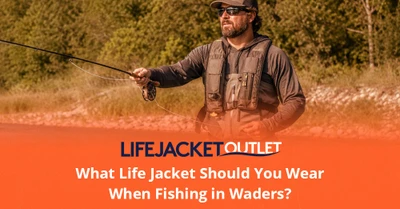
An angler wearing chest waders should use a life jacket that remains secure above the wader belt, supports the airway automatically after an unexpected fall and is compatible with the full clothing system. For many boat and exposed-shore anglers, the practical starting point is a Level 150-class automatic inflatable life jacket; heavy clothing, offshore exposure or commercial requirements may justify a higher-buoyancy model.
Waders do not simply “drag a person straight to the bottom”, but flooding, trapped air, restricted movement and difficult recovery can turn a survivable fall into an emergency. The life jacket, wader fit, communication method and route out of the water must be planned together.
For commercial fishing, separate legal duties apply
MCA guidance requires the provision and wearing of suitable PFDs where a fishing-vessel risk assessment identifies a risk of falling overboard. This article also covers leisure angling, but commercial operators must follow the current fishing-vessel rules and documented risk assessment.
Contents
- The short answer
- Why waders and heavy clothing change the risk
- Automatic or manual inflation for fishing?
- 150N or 275N with waders?
- Shore, boat and kayak fishing
- Fit over waders and fishing clothing
- Features worth prioritising
- Plan the recovery, not only flotation
- Commercial fishing-vessel requirements
- Fishing life jacket checklist
- Frequently asked questions
- Technical references
The short answer
For most boat or rock anglers wearing waders where an unexpected fall could leave them unable to help themselves, a correctly fitted automatic inflatable life jacket of at least the appropriate Level 150 class is the usual starting point. Heavy clothing, flotation suits, extreme conditions or commercial work may justify a higher-buoyancy product after a risk assessment. Wading anglers need a high-cut design that does not conflict with the wader belt or casting movement.
Waders are not a substitute for a life jacket. Water inside waders does not become mysteriously heavier underwater, but flooded clothing can restrict leg movement, make climbing out extremely difficult, trap air in awkward places and complicate rescue. Cold water shock can also remove the ability to inflate a manual device or swim effectively within seconds.
Why waders and heavy clothing change the risk
Waders create several linked problems. They can fill rapidly at the top, create drag when the wearer tries to climb a ladder or steep bank, and restrict kicking. Trapped air can move into the legs and influence body orientation. Boots and layers can make self-rescue onto rocks, a bank or a boat much harder. None of these effects is solved by being a strong swimmer in a pool.
The first hazard is often cold water shock: involuntary gasping, rapid breathing and loss of controlled movement. A life jacket that inflates automatically supports the wearer while they concentrate on protecting the airway and controlling breathing. The second hazard is prolonged exposure. A life jacket is not thermal protection, so a means of raising the alarm and a realistic recovery plan remain essential.
| Hazard | Effect on the angler | Equipment or planning response |
|---|---|---|
| Cold water shock | Gasp reflex, rapid breathing, panic and reduced ability to pull a toggle. | Automatic inflation, secure fit, crotch straps and pre-planned Float to Live response. |
| Flooded waders | Restricted leg movement and difficult climbing or bank exit. | Wader belt, high-cut jacket, accessible exit points and assisted recovery equipment. |
| Trapped air in clothing | Can alter body orientation and impede self-righting. | Assess clothing with the chosen life jacket; consider higher performance where justified. |
| Rocks, hooks and equipment | Puncture, entanglement or inability to reach safety gear. | Low-snag layout, protected bladder, line cutter/knife where appropriate and tidy tackle. |
| Remote fishing location | Delayed rescue and poor mobile coverage. | Wearable PLB or suitable communication device kept on the person. |
| Night or poor visibility | Difficult detection after a fall. | Life jacket light, reflective material and trip plan. |
| Breaking waves and spray | Repeated water over the face even while afloat. | Compatible spray hood for relevant boat/coastal use. |
Browse life jackets selected for fishing use
Compare low-profile automatic, harness and higher-buoyancy models with the clothing and fishing method in mind.
Automatic or manual inflation for fishing?
Automatic inflation is generally the stronger choice when a fall is unexpected, the angler may hit their head, the water is cold or the wearer could become tangled. It removes the need to locate and pull the manual toggle during the most disorientating seconds. All users should still know where the backup toggle is and how to use the oral tube.
Manual inflation can suit specialist situations in which regular immersion, heavy rain, surf or wading creates an unacceptable risk of nuisance activation and the wearer is trained, conscious and capable of acting. The choice needs care: a manual jacket provides no gas buoyancy until it is deliberately fired. Waist-belt devices that require secondary donning are particularly unsuitable where cold shock or unconsciousness is foreseeable, and they are not accepted for certain commercial fishing-vessel requirements.
Hydrostatic automatic systems can reduce activation from spray and rain because they respond to submersion pressure rather than simple surface wetting. They are often more expensive and require model-specific servicing and Hammar re-arming kits. Choose the mechanism after defining the fishing environment, not from price alone.
150N or 275N with waders?
A Level 150-class jacket is designed for general offshore and rough-weather use and is a common minimum for automatically inflated commercial fishing-vessel PFDs. It can support a fully clothed wearer, but actual self-righting is affected by trapped air and heavy gear. Level 275 products are intended for more demanding offshore use and heavy protective clothing that may adversely affect lower-level turning performance.
Do not choose 275N purely because waders look heavy. Consider the whole clothing system, body shape, sea state, likely rescue time, tools and whether the wearer can be recovered while the large bladder is inflated. A 275N-class jacket can be bulkier for casting and may be more difficult to climb in. A supervised in-water evaluation using safe facilities and manufacturer guidance is valuable for unusual clothing systems.
The full 150N versus 275N guide provides a broader comparison. For many leisure anglers, a comfortable 150N–190N automatic model that is worn continuously is the practical choice; demanding commercial and offshore scenarios may require more.
Shore, boat and kayak fishing
| Fishing method | Product considerations | Additional priorities |
|---|---|---|
| Rock or shore angling | Low-profile automatic life jacket or suitable angling PFD; high-cut design over waders. | Grip, escape route, tide, wave exposure, PLB/phone on person and buddy system. |
| Small open boat | Automatic life jacket with secure crotch strap; harness only where clipping on is properly arranged. | Kill cord, recovery ladder, throw line, light and communication. |
| Offshore charter or private boat | 150N–275N class according to clothing, conditions and vessel requirements; spray hood and light strongly considered. | Crew brief, MOB recovery equipment and locator beacon. |
| Kayak fishing | Activity-specific foam buoyancy aid is often preferable because immersion and self-rescue are foreseeable. | Paddle freedom, pockets, knife, whistle, communication and attachment to the person. |
| Commercial fishing vessel | Automatically operating PFD meeting the applicable MCA performance and approval requirements. | Documented risk assessment, training, maintenance records, fit and PLB compatibility. |
A conventional automatic yacht jacket can inflate during a kayak capsize and impede re-entry, whereas a kayak buoyancy aid supports swimming and self-rescue. By contrast, a low-buoyancy foam aid may not be enough for a lone angler on an offshore motorboat who could be unconscious. Match the PFD to the method, not simply the fact that all users are “fishing”.
Fit over waders and fishing clothing
Put on the full wader system, belt, insulation and outer jacket before fitting the life jacket. The waist belt of the life jacket should sit in its intended position and must not be confused with the wader belt. Tighten the life jacket so it cannot be pulled over the head, and use its crotch or thigh straps. Check that the top of the waders does not cover the manual pull toggle.
Cast, bend, sit, climb a safe practice step and reach every pocket. Hooks, forceps and net handles must not sit against the bladder or operating head. A fishing vest worn over the life jacket can prevent inflation unless the manufacturer specifically approves the combination. Use jacket-integrated or low-profile storage instead of strapping rigid tackle across the inflatable chamber.
Features worth prioritising
- Automatic inflation: particularly important for sudden falls, cold water and possible unconsciousness.
- High-cut, low-profile shape: improves casting and clears the wader belt.
- Crotch or thigh straps: reduce ride-up and help keep the airway higher.
- Durable wipe-clean cover: useful around bait, fish slime and regular deck use, provided the bladder remains protected.
- Life jacket light: improves detection in darkness or poor visibility.
- Spray hood: protects the airway in waves and wind-blown spray during boat or exposed coastal use.
- PLB provision: lets a remote angler carry a recognised distress alert on the person.
- Whistle and reflective material: simple, reliable signalling aids.
- Harness where appropriate: useful on a properly equipped sailing or workboat, but not a substitute for suitable strong points and recovery planning.
Browse compatible lights, spray hoods and personal locator beacons only after confirming they can be fitted without interfering with inflation.
Plan the recovery, not only flotation
A life jacket can keep an angler afloat while the vessel crew discovers that a high freeboard, flooded waders and a large body make recovery extremely difficult. Fit a boarding ladder or recovery system that can be deployed from the water where practicable. Carry a throw line, and practise a controlled man-overboard recovery with a training dummy or suitably managed drill.
For shore anglers, identify low exits before fishing and avoid being cut off by tide. Tell someone the location and return time. Keep the communication device on the body in a waterproof arrangement, not in a tackle box that remains on the rock. The existing guide on carrying a PLB explains satellite alerting and registration.
Commercial fishing-vessel requirements
MCA MGN 588 Amendment 2 states that owners must provide and require the wearing of suitable PFDs where a risk of falling overboard remains. Where a PFD of at least 150N is not worn, the documented risk assessment must demonstrate an equivalent level of safety. Automatically operating or automatically inflated PFDs on fishing vessels have a minimum performance standard of 150N in the guidance; manual-only and secondary-donning waist devices are not accepted for that purpose.
The guidance also emphasises correct fitting, use of crotch straps where required, crew training, maintenance records and compatibility of any PLB with the PFD. Commercial operators should select from commercial life jackets only after checking the current approval and vessel code. A leisure retail description is not evidence of regulatory compliance.
Fishing life jacket checklist
- Define whether the use is leisure, charter, work or commercial fishing.
- Assess the fall risk, cold-water exposure, sea state and time to rescue.
- List waders, flotation clothing, tools and equipment worn on the body.
- Choose automatic, hydrostatic or manual activation using the full risk—not nuisance inflation alone.
- Select buoyancy level and approval appropriate to the conditions and rules.
- Fit over full clothing and complete an upward retention and movement test.
- Use crotch straps and keep the pull toggle clear of waders and tackle.
- Add a compatible light, hood and personal communication device where required.
- Provide an effective route out of the water and practise recovery.
- Inspect before every use and service at the manufacturer or regulatory interval.
Frequently asked questions
Do waders pull you to the bottom?
Water inside waders does not weigh more than the surrounding water, but flooded waders can restrict movement, create drag during exit, trap air and make climbing or recovery extremely difficult. Wear a suitable life jacket and wader belt.
Should I wear an automatic life jacket while wading?
Automatic inflation can be valuable for an unexpected fall and cold shock, but regular deep wading or heavy splash may affect mechanism choice. Consider a hydrostatic or activity-specific product and follow the manufacturer’s intended use.
Is 150N enough with chest waders?
It may be for many users, but heavy clothing and trapped air can alter turning performance. Assess the complete clothing system, conditions and recovery plan; consider a 275N-class product where the risk justifies it.
Can I wear a fishing vest over an inflatable life jacket?
Only if the life jacket manufacturer explicitly approves the arrangement and inflation is not restricted. Rigid pockets, tools and straps can obstruct or damage the bladder.
Do commercial fishermen have to wear life jackets?
MCA guidance requires suitable PFDs to be provided and worn where the fishing-vessel risk assessment identifies a risk of falling overboard, unless equivalent safety is demonstrated under the applicable rules. Consult the current MGN and vessel code.
What PFD should I use for kayak fishing?
A secure, activity-specific foam buoyancy aid is commonly more suitable because capsize, swimming and self-rescue are foreseeable. Offshore and unusual scenarios require an individual assessment.